
I Woke Up Gasping for Air. What Just Happened?
I Woke Up Gasping for Air. What Just Happened?
By Dr Jodie-Ann Senior, Cardiologist & Heart Failure Specialist | drjodieannsenior.com
You woke up in the middle of the night unable to breathe — gasping, panicking, not sure what was happening. And now you're trying to make sense of it.
This article will tell you exactly what that was, what to do if it happens again, and how to stop it happening in the first place.
[Episode 3: I woke up gasping for air. What just happened?]
What Just Happened — The Simple Explanation
What you experienced has a medical name: paroxysmal nocturnal dyspnoea. PND for short.
'Paroxysmal' means it came on suddenly. 'Nocturnal' means at night. 'Dyspnoea' means breathlessness. Sudden breathlessness at night. That is exactly what it was.
Here is why it happens.
During the day, while you are sitting or standing, gravity keeps a lot of your excess fluid in your legs. You might notice ankle swelling — that is the fluid pooling there. Your body manages it while you are upright.
But when you lie flat to sleep, gravity is no longer doing that work. The fluid that has been sitting in your legs all day starts to redistribute back through your circulation. It moves upward, toward your chest. Your heart — which is already working harder than it should — suddenly has more fluid to manage than it can handle.
The excess fluid backs up into the lungs. The lungs fill with fluid. Your brain wakes you up.
Think of it this way: the heart is a pump. The lungs are a sponge. When the pump can't keep up with the flow, the sponge gets waterlogged — and a waterlogged sponge can't get oxygen into your blood.
That is why you woke up gasping. Your body's alarm system worked exactly as it should — it woke you up before things got worse.
The sitting upright, the rushing to the window, the gasp for air — your instincts were correct. Sitting up lets gravity help again. The fluid shifts back downwards. The lungs can breathe. The episode may pass.
It is terrifying. But it is your body protecting you.
What to Do if It Happens Again Tonight
If this happens again, here is exactly what to do — step by step.1
Sit up immediately.
Don't try to ride it out lying down. Sit up — legs over the edge of the bed if you can. Let gravity help move the fluid away from your lungs. This is the single most important step.2
Stay calm — your body is already responding.
Panic makes breathlessness feel worse. Remind yourself: sitting up will help. Focus on slowing your breath. The episode will pass, or get your breathing under enough control to call for help.3
Wake someone if you are not alone.
Don't manage this in the dark by yourself. Wake your partner or anyone in the house. Having someone with you helps with both safety and staying calm.4
Open a window if it helps.
Fresh air does not treat the underlying problem, but it can ease the feeling of breathlessness. If it helps you stay calm, open it.5
Take note of how long the episode lasts.
Once you are sitting up and beginning to feel better, note how long the episode lasted. Most PND episodes settle within ten to twenty minutes of sitting up. This information is useful for your doctor.
When to Call Emergency Services
Sitting up and waiting is usually enough — but not always. Call 000 in Australia (999 in the UK, 911 in the US) if any of the following are true.
•The breathlessness is not settling after 10–15 minutes of sitting upright.
•You have chest pain or pressure.
•You feel faint or like you might pass out.
•Your lips or fingertips look blue or grey.
•This is the first time this has happened and you are not sure what it is.
•You live alone and you are frightened.
If you are not sure whether to call — call. This is not a situation where caution is the wrong choice.
If you are unsure how to decide, my article on when to go to hospital with heart failure covers this in full — link below.
What This Means for Your Heart Failure Going Forward
Here is the most important part of this article.
Paroxysmal nocturnal dyspnoea or PND is a sign that fluid is building up faster than your body is clearing it. It means your heart failure is under more strain than usual — and that your medications may not be keeping pace.
It does not always mean you need to go to hospital. But it always means you need to speak to your doctor or heart failure nurse — not at your next scheduled appointment in three weeks, but at least the next day.
The warning that was probably already there
This is the part that matters most for preventing the next episode.
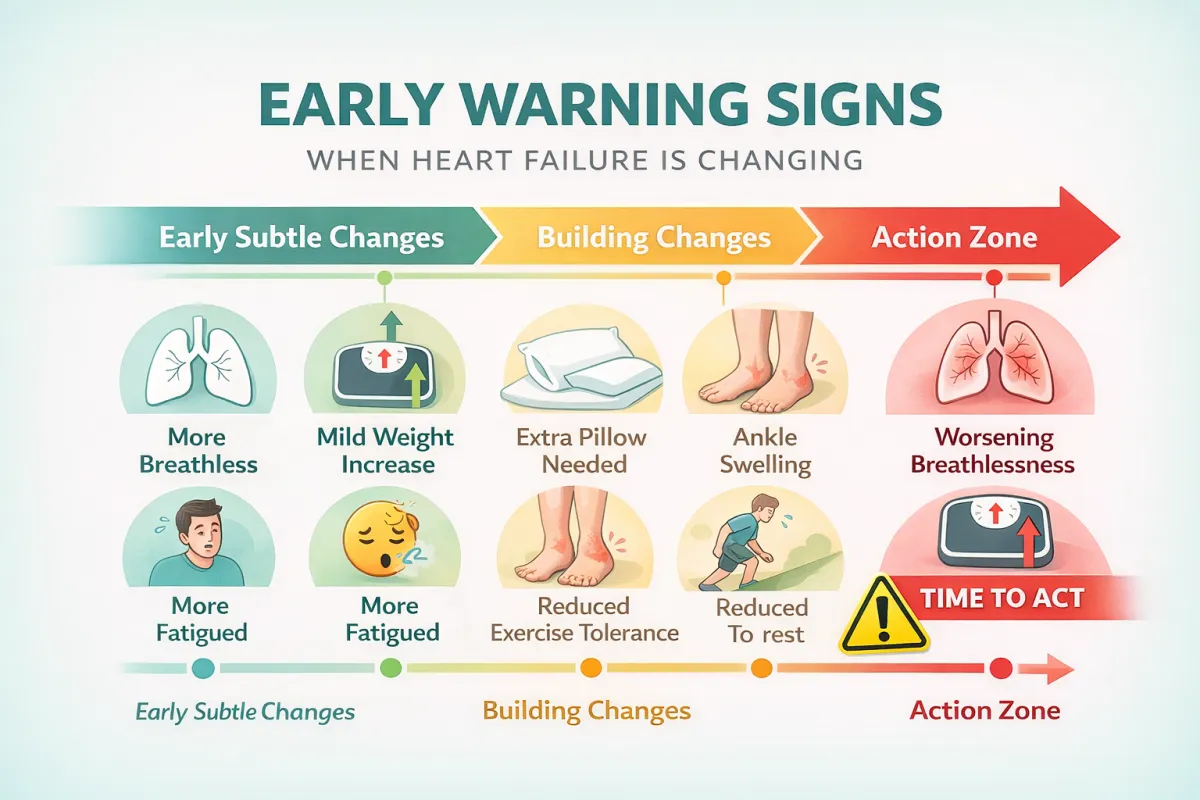
In the days leading up to PND episodes, patients have already been gaining fluid. One kilogram. Two kilograms. Sometimes three. The weight was going up — but because they were not weighing daily, or because the ankle swelling felt normal, or because the fatigue just felt like a bad week, the signal was missed.
That weight gain is the warning. And it is catchable — if you are weighing yourself every morning.
Daily weighing is not optional in heart failure. Don't go 'weigh yourself when you feel worse' or on a random basis. Every morning. Same time. After the toilet. Before eating or drinking. The number on the scale is your early warning system.
The Four Zones™ action plan — which is inside the Heart Failure Tracking Kit — is built around exactly this method. Each morning, you weigh in and check where you sit.GREEStable
Within 1 kg of your goal weight. Feeling well. Continue your normal routine.AMBERCaution
Up 1–2 kg. Mild new symptoms. Restrict fluids and salt. Call your clinic within 24 hours if no improvement.ORANGAct Soon
Up more than 2 kg. Worsening symptoms. Contact your GP or specialist within 24 hours — this level of fluid gain needs a medication review.REEmergency
Severe breathlessness, chest pain, can't lie flat, feel faint. Call emergency services. Do not wait.
If your weight had been tracked in the days before last night's episode, there would almost certainly have been an Amber or Orange Zone reading — a signal that, if acted on, might have prevented the episode altogether.
That is what the Tracking Kit is for. Download it below. Print it. Start using it tomorrow morning.
Free Download — Heart Failure Tracking Kit https://www.hftk.drjodieannsenior.com
Includes The Four Zones™ daily action plan, a weight and symptom diary, and exercise effort guidance. One page. Print it. Put it next to your scales.
Download free at drjodieannsenior.com→[LINK https://www.hftk.drjodieannsenior.com ]
The Bottom Line
What happened to you is called paroxysmal nocturnal dyspnoea or PND. It happens when fluid from your legs redistributes while you lie flat, your heart can't keep up, and your lungs fill with fluid. It is terrifying — and it is your body trying to help you survive.
If it happens again: sit up, stay calm, wake someone, and note a sense of how long the episode lated. If it does not settle within ten to fifteen minutes — or if you have chest pain, feel faint, or you are not sure — call emergency services.
Tell your doctor what happened. As soon as it is practical. Start daily weighing if you have not already. And download the Tracking Kit so you have a system that catches the warning signs before the next episode.
If this article was helpful, my YouTube channel has a full video on this topic with more detail — and a new video every week answering the questions heart failure patients are actually asking. Search @DrJodie-AnnSenior on YouTube.
Related Articles
•My Doctor Said I Need to Go to Hospital — Do I Really Need to Go?→
]
•My Heart Failure Is Getting Worse — How Do I Know?→
•My Legs Are So Swollen I Can't Put My Shoes On — What Do I Do?→[link to Video 4 article]
•Download the Heart Failure Tracking Kit (The Four Zones™)→[ https://www.hftk.drjodieannsenior.com
This article is for general patient education only and does not constitute medical advice for your individual circumstances. Always speak with your own doctor or heart failure care team about your specific situation.
Aligned with the NHFA/CSANZ 2018 Guidelines for the Prevention, Detection and Management of Heart Failure in Australia.
© 2026 Dr Jodie-Ann Senior. All rights reserved. drjodieannsenior.com