When Do I Need To Go To Hospital?
Should I Go to Hospital? Do I Really Need to?
By Dr Jodie-Ann Senior, Cardiologist & Heart Failure Specialist | drjodieannsenior.com
Your doctor / family / friend has just told you to go to hospital — and you're sitting there wondering whether you really need to. You’re thinking…”I don’t feel that bad” or “surely this will pass if I just wait”. You probably don’t want to make a fuss or waste anybody’s time. Let me give you the inside tip on this one… No one will think you are wasting their time. Or maybe you're not going because you are scared of what happens when you arrive at hospital.
That hesitation is completely understandable. But it can also be dangerous. In this article, I'll help you make that call — clearly, calmly, and safely. As an expert, let me guide you here. Don’t make the mistake of leaving it too late when getting help early is so valuable. And always err on the side of caution.
[Video - My doctor said I need to go to hospital. Do I really need to go?]
Why People With Heart Failure Hesitate
People with heart failure often build up an extraordinary tolerance for feeling unwell. You learn to manage your symptoms. You learn to push through fatigue, to sleep sitting up, to plan your day around how breathless you'll be. So when things get worse, the natural instinct can be to apply the same approach — wait, see if it settles, try not to make a fuss.
I get it. I see this in clinic and in the hospital all the time. And I understand it. But here is what I need you to know:
With heart failure, the gap between 'I'll wait a little longer' and 'I needed to go hours ago' can close faster than you think.
Going to hospital earlier almost always means a shorter stay, less aggressive treatment, and a faster return home. Delaying almost always means a longer hospital stay, more aggressive treatment strategies with higher risk — more fluid to shift, more strain on your heart and kidneys, more time on a ward.
So rather than guessing, let me give you the specific signs to look for.
Five Signs That Mean Go Right Now
These are not 'call your GP in the morning' situations. If you have any of the following, please go to your emergency department — or in Australia, call 000.
1.Severe breathlessness at rest — or with the smallest effort
Not breathless after walking upstairs. This is - Breathless sitting still. Breathless getting dressed. Breathless talking, eating or just walking to the bathroom.
Think of the heart as a pump and the lungs as a sponge. When the pump isn't keeping up, fluid backs up into the sponge — into your lungs. When enough fluid builds there, breathing becomes genuinely hard. Not uncomfortable. Strained. Difficult.
This is a Red Zone situation in The Four Zones™ action plan. The instruction is clear: don't wait.
2.You can't lie flat — you need to sleep sitting up
If you're propped up on three or four pillows, or you've moved to sleeping in a chair because lying flat makes you too breathless — this is a significant symptom. The medical term is orthopnoea.
When you lie flat, fluid in your body redistributes and rushes back toward the lungs. Your body forces you upright to compensate. This is your body sounding an alarm. Please listen to it.
3.Chest pain or pressure
Tightness, heaviness, pressure, or squeezing in the chest. This is not a symptom to manage at home in a heart failure patient. People often think that the problem or pain should be severe (crushing – like a heart attack). It’s more likely to be uncomfortable rather than painful. People often say “oh but it doesn’t hurt… it’s not painful. So I didn’t know it was my heart”.
People with heart failure can develop other cardiac problems — including blocked arteries — on top of their existing condition. Chest pain (heaviness / pressure / tightness and crushing) is an emergency until it is proven otherwise.
4.You passed out, nearly passed out, or feel like you might
Blackouts and near-blackouts — or a feeling that you're about to pass out — can signal that the heart's electrical system is struggling, or that your blood pressure has dropped to a concerningly low level. Either way, that’s a sign that you don’t ignore. Call an ambulance or ask someone to drive you to the Emergency department, straight away.
5.Rapid weight gain combined with worsening symptoms
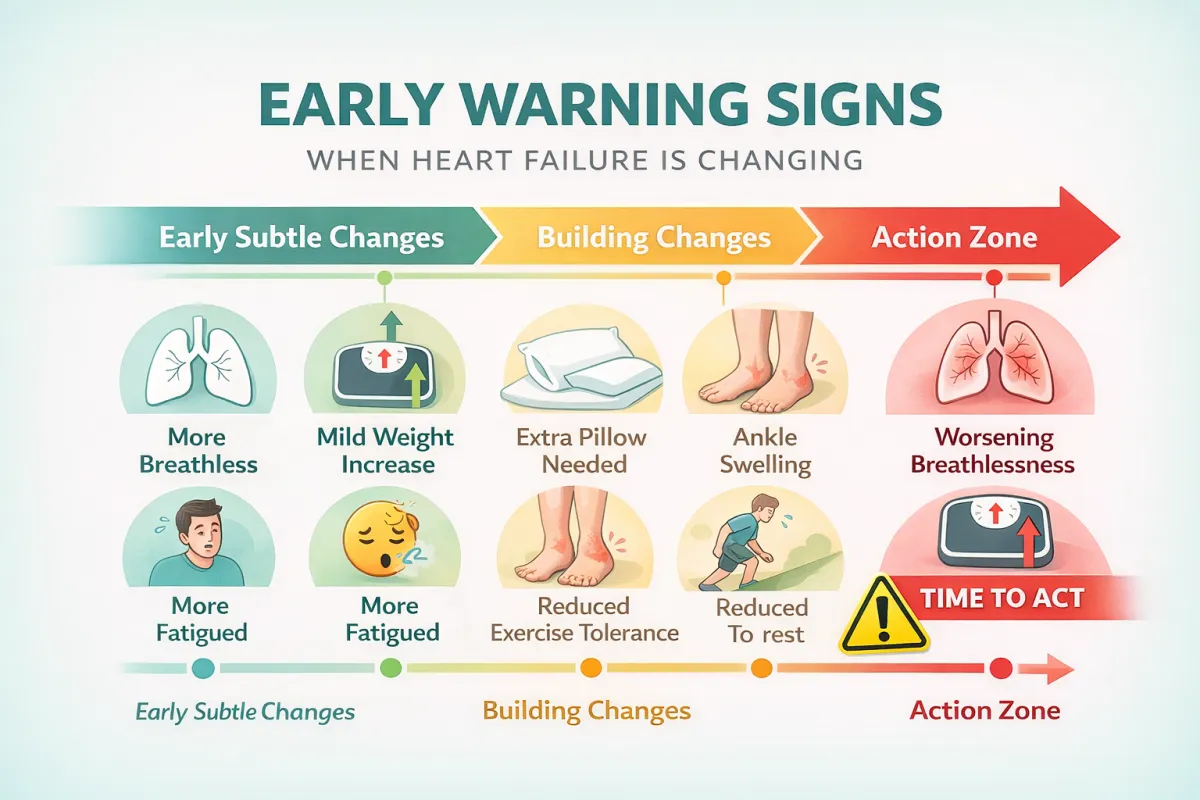
If you've gained more than two kilograms in the last 24 to 48 hours and your symptoms are noticeably worse — more breathlessness, more swelling, more fatigue — this is a serious red flag.
Rapid weight gain in heart failure is fluid gain. Two kilograms of extra fluid in less than two days means your body is retaining what it should be getting rid of, and your medications aren't keeping pace. This combination warrants urgent assessment, or an agreed change in your treatment plan.
To summarise where these signs sit in The Four Zones™ action plan:
GREEN
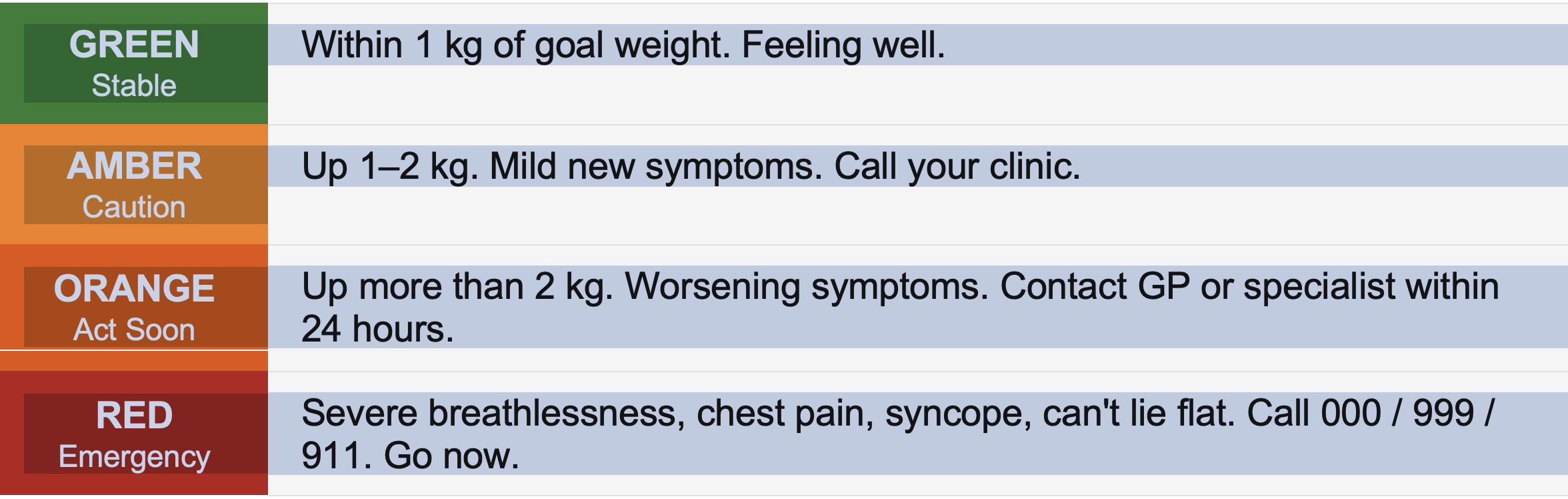
The Heart Failure Tracking Kit — which you can download free below — has The Four Zones™ printed as a one-page action plan. It tells you exactly what to do based on your weight and symptoms, so you never have to guess.
When a Phone Call to Your Doctor Is Enough
Not every situation means heading straight to the emergency department. There is an important middle ground — and knowing it can actually help you avoid an admission altogether.
If your symptoms are new or worsening but you are not in immediate distress, calling your heart failure nurse, GP, or cardiologist's rooms first is reasonable. They may be able to adjust your medications and manage the situation from there.
The kinds of situations where a phone call first makes sense:
•Your weight has crept up 1–2 kg above your usual, but you feel only mildly more breathless or swollen — not dramatically worse.
•Your ankles are more swollen than usual, but you're not breathless at rest and you can still lie flat.
•You're more fatigued than normal, but your other symptoms haven't changed much.
These are Amber and Orange Zone situations. Your body is sending a message, but there is still a window to act.
One practical tip: when you call, lead with your weight. Tell them how many kilograms above your usual weight you are. This immediately focuses the clinical conversation on what matters most.
Important: If you call and can't get through, or your symptoms are getting worse while you wait — don't sit on it. Go.
What Actually Happens When You Get to Hospital
One of the biggest reasons people delay going in is fear of the unknown. So let me take that away.
When you arrive with worsening heart failure, you'll be assessed in the emergency department — observations, blood tests (including a BNP level and kidney function), a chest Xray and an ECG. If you're short of breath, you'll likely receive oxygen and IV diuretics — medication given directly into a vein to help your body remove excess fluid quickly. Most people feel meaningfully better within the first 24 hours. A typical admission for a heart failure flare lasts two to five days, with the goal of getting you dry, getting your medications optimised, and getting you home safely.
It is not a pleasant experience. But it is a correctable one. And the sooner you go when you need to, the faster the correction happens. If you wait, things can be a lot worse.
What to Bring if You Are Going In
Being prepared doesn't mean assuming the worst. It means being sensible about your own health.
•A list of all your current medications and doses — or the actual boxes.
•Your Heart Failure Tracking Kit, or a note of your recent weights and which zone you've been in.
•Your care team contact details — cardiologist, GP, heart failure nurse.
•Phone charger, comfort items, and an overnight bag. Even if you expect a short visit, be prepared.
The Bottom Line
If you have severe breathlessness at rest, can't lie flat, have chest pain, have nearly passed out, or have gained more than two kilograms quickly with worsening symptoms — please go. Don't wait.
If your symptoms are worsening but you're not in immediate distress — call your team first. But if you can't reach them, or things are getting worse while you wait, go.
And if you're not sure — go. A precautionary trip to hospital is always better than a delay that wasn't. What’s the worst that happens? They send you back home without admitting you as things aren’t as bad as you thought? Still a win in my book. I’ve seen too many of the other side of that coin……
Free Download — Heart Failure Tracking Kit
The Four Zones™ action plan tells you exactly what to do based on your weight and symptoms — Green, Amber, Orange, or Red — every single day. Print it out. Put it where you can see it. Know your zones.
Download free at drjodieannsenior.com → [ https://www.hftk.drjodieannsenior.com ]
If this article helped you, my YouTube channel has a full video on this topic with more detail — and a new video every week answering the questions heart failure patients are actually asking. Search @DrJodie-AnnSenior on YouTube, or follow the link in the navigation above.
Related Articles
•My Heart Failure Is Getting Worse — How Do I Know?→
•My Feet Are So Swollen I Can't Put My Shoes On — What Do I Do?→
•The Four Zones™ — Your Daily Heart Failure Action Plan→ https://www.hftk.drjodieannsenior.com
This article is for general patient education only and does not constitute medical advice for your individual circumstances. Always speak with your own doctor or heart failure care team about your specific situation.
Aligned with the NHFA/CSANZ 2018 Guidelines for the Prevention, Detection and Management of Heart Failure in Australia.
© 2026 Dr Jodie-Ann Senior. All rights reserved. drjodieannsenior.com