

What Happens If I Miss A Dose Of My Heart Failure Medications?
What Happens If I Miss a Dose of My Heart Failure Medication?
By Dr Jodie-Ann Senior | Cardiologist & Heart Failure Specialist
You forgot your tablets this morning. Maybe you were rushing, maybe the routine got broken, maybe you only realised halfway through the day.
And now you're wondering: have I done damage? Do I take two now to catch up? Or do I just carry on?
Let's face it — nobody sets out to miss a dose. Life gets busy, routines get disrupted, and tablets are easy to overlook if you are feeling ok. It happens. What matters is what you do next.
So let's talk through it properly — medication by medication — because the answer isn't quite the same for all of them.
Why Consistency Matters So Much in Heart Failure
Heart failure medications aren't like pain relief — you don't take them, feel the effect, and have them leave your system. They're working continuously in the background: blocking the hormones that strain your heart, protecting the muscle from ongoing damage, managing fluid at a hormonal level.
That protection is cumulative. It builds over months and years. And it depends on consistent daily use to maintain.
One missed dose in an otherwise reliable routine is not going to undo your progress. But missed doses that happen regularly — or that quietly become a pattern — allow the conditions that damage the heart to creep back in.
The goal isn't perfection. The goal is a system reliable enough that missing a dose is the exception, not a habit.
What To Do — Medication by Medication
Different medications carry different levels of concern when a dose is missed. Here's a clear breakdown.
M
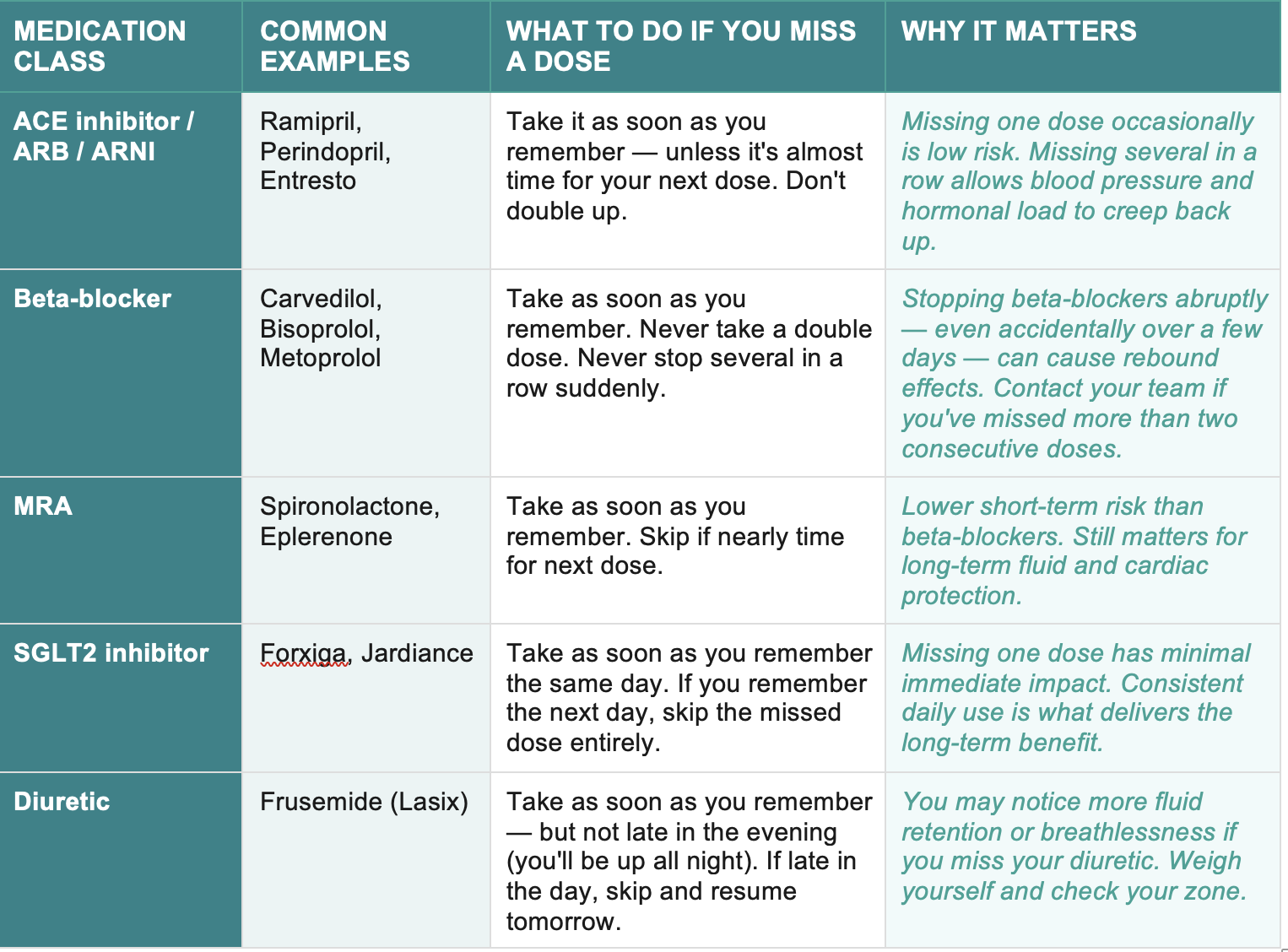
The One Rule That Applies to Every Medication
Never take a double dose to make up for a missed one.
It feels logical — you missed one, so you take two to catch up. But most heart failure medications don't work that way. A double dose doesn't deliver twice the protection. What it can deliver is a significant drop in blood pressure, dizziness, nausea, or worse — problems that are considerably more serious than the original missed dose.
One dose missed. One dose skipped. Back to your normal schedule. That's the rule. This is especially true for any medications that slow down clotting (you might know these as "blood thinners". ) Do NOT double up on these. And, like the odd patient I have come across, if they are meant to be taken morning and night, don't just unilaterally decide to take the whole dose all at once each day instead of in split doses... this is especially dangerous. They have about a 12 hour window of working and if you double up, this can lead to higher bleeding risk, but also a period following that when you could clot easier.
When To Contact Your Care Team
Most of the time, a single missed dose can be managed with the guidance above. But there are situations where you should contact your GP or heart failure nurse rather than simply resuming your medication:
• You've missed more than two consecutive doses of your beta-blocker
• You've missed several days of any medication and aren't sure whether to restart at your usual dose
• You missed your diuretic and your weight has gone up more than two kilograms, or your breathlessness has noticeably worsened
• You feel unwell in a new way after missing doses — particularly palpitations, increased breathlessness, or chest discomfort
• You're unsure about anything — when in doubt, call
Your care team would always rather hear from you than have you quietly manage something that needs attention.
A Note on the Beta-Blocker — Why It Carries the Most Risk
Of all the heart failure medications, the beta-blocker carries the highest short-term risk if missed repeatedly or stopped abruptly.
Beta-blockers work by blocking adrenaline at the heart — slowing it down and reducing its workload. When you stop them suddenly, your body's adrenaline system can rebound. The heart rate can spike. Blood pressure can rise sharply. Some people experience palpitations or feel significantly more breathless.
This isn't a reason to be frightened — it's a reason to be careful. If you've missed several consecutive doses of your beta-blocker, don't simply restart at your usual dose without speaking to your team first. They may recommend a temporary reduction before building back up.
Building a System — Because Willpower Isn't Enough
Most people who miss their medications aren't being careless. They're busy, their routine shifted, and the tablets slipped through a gap.
Willpower is not a reliable system for daily medication. A good system is.
Things that genuinely help:
• A weekly pill organiser filled every Sunday. At a glance, you can see whether today's compartment is empty or full.
• A phone alarm set to your medication time — the same time, every day, as a non-negotiable.
• Keeping your tablets next to something you do every morning without fail — your kettle, your toothbrush, your coffee cup.
• A medication diary or tracking chart — my free Heart Failure Tracking Kit includes this — so you have a written record of what you've taken and when. (Get this at https://www.hftk.drjodieannsenior.com )
The goal is to make taking your medication the path of least resistance. Not a decision that requires active thought each day.
And if side effects are what's making it genuinely hard to take your medications consistently — please tell your team. There are almost always options: a dose adjustment, a timing change, a switch to an alternative. But those options only open up when your team knows what's happening.
A Final Word
Forgetting a tablet occasionally is part of being human. What matters is how you respond — and whether your day-to-day system is reliable enough that it stays an occasional thing.
One missed dose: take it as soon as you remember, don't double up, and get back to your routine. Multiple missed doses, especially of your beta-blocker, or symptoms that have shifted: call your team.
Your medications are doing quiet, important, cumulative work for your heart every single day. They deserve a reliable routine — and so do you.
📋 Free downloads:
💚 Heart Failure Tracking Kit (daily symptom + medication diary, The Four Zones™): https://www.hftk.drjodieannsenior.com
📄 My Heart Failure Stage — Personal Reference Guide: https://www.hfsg.drjodieannsenior.com
▶️ Watch the video version:
📖 More: drjodieannsenior.com/blog
Aligned with the NHFA/CSANZ 2018 Guidelines for the Prevention, Detection and Management of Heart Failure in Australia.
This article is for educational purposes only. It is not a substitute for individual medical advice from your own healthcare team.
Heart Failure Help Now|drjodieannsenior.com|Dr Jodie-Ann Senior, Heart Failure Specialist