
My Legs Are So Swollen I Can’t Put My Shoes On. What Do I Do?
My Legs Are So Swollen I Can’t Put My Shoes On. What Do I Do?
By Dr Jodie-Ann Senior·Heart Failure Specialist·drjodieannsenior.com
When Your Shoes Won’t Fit
You went to put your shoes on this morning and you couldn't squeeze your feet in to them. They just wouldn't go.
Your ankles are puffy. Your legs feel heavy. And now you’re wondering: is this serious? Should I be worried? Do I need to call someone?What is going on here? Why are my feet swelling like this? And if you're wondering if this is just a local problem in your feet... you'd probably be wrong. At least in this context. And if that's the case, then where is the problem?
These are exactly the right questions to be asking.
Swollen legs and ankles are one of the most common symptoms of heart failure — and yet not one of the most distressing. But it is genuinely a problem since it causes difficulty in feeling the floor, which can mean people have more trouble walking around. Additionally, it can cause weeping of the skin and this is really problematic due to risk of infection or cellulitis. This one can put you in hospital for a serious amount of time, while you get treated with intravenous antibiotics. And whilst this is one of the most common things that happens, most patients don’t get a clear explanation of what it means or what to do.
Today, I want to change that.
Why Fluid Builds Up in Your Legs
I want to explain this with a simple image, because I think it helps.
Think of your heart as a pump, and the tissues in your body as a sponge.
When the heart is pumping well, blood flows efficiently around the body. Fluid stays inside the blood vessels where it belongs.
But when the heart is struggling — when it can’t pump as powerfully as it should — blood starts to back up in the veins. The pressure inside those veins rises.
And when the pressure gets high enough, fluid leaks out of the blood vessels and into the surrounding tissues. Because of gravity, it sinks to the lowest point in your body — your ankles, feet, and legs.
That’s the sponge getting waterlogged, if in this case, the sponge is the soft tissues in your feet and legs.
The medical term for it is peripheral oedema. But what it really is, is your body raising a flag.
What the Swelling Is Telling You
Not all leg swelling means the same thing. Here’s what I want you to pay attention to.
If you’ve had mild ankle puffiness for a while and it hasn’t been changing, I want to be honest with you: ideally, heart failure patients shouldn’t have any ankle swelling at all. The goal of good heart failure management is getting to what we call euvolaemia — the point where your fluid balance is as close to normal as possible. So even stable, long-standing swelling is worth discussing with your team. There are exceptions — if you also have varicose veins, venous insufficiency, or poor kidney function that makes it difficult to remove fluid without causing other problems, some residual swelling may be the practical reality for you. But that conversation belongs with your cardiologist, not in a shrug of “that’s just how it is.”
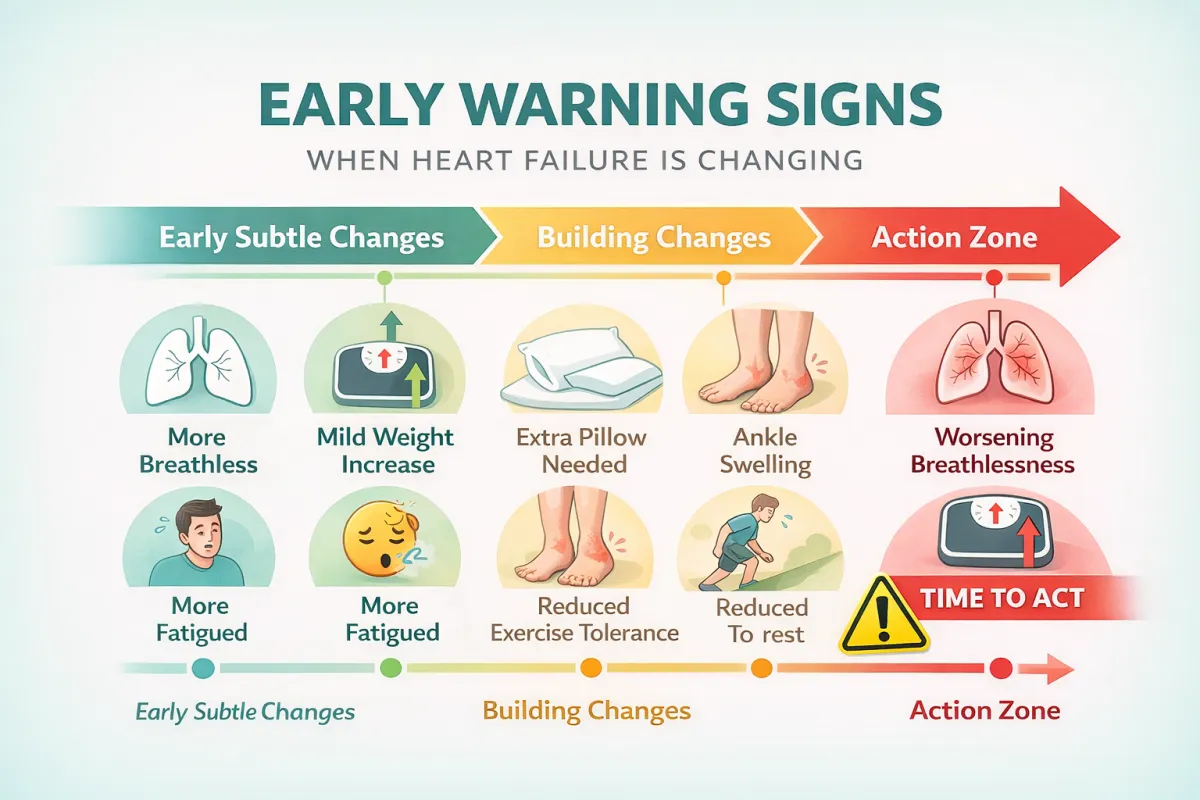
But these signs mean something is changing:
✔The swelling is new, or noticeably worse than usual
✔It’s moving higher — above the ankle, toward the knee
✔You’re gaining weight at the same time — even one or two kilograms in a few days
✔You’re more breathless than usual
✔You’re waking up at night to breathe, or need more pillows than normal
When these things happen together, fluid isn’t just sitting there — it’s accumulating. And in heart failure, accumulating fluid means your heart is under more strain than it should be.
This is your body asking for help. The question is: what kind of help, and how urgently?
Your Action Plan: The Four Zones™
I use a four-zone framework with my patients to answer exactly this question. Each zone tells you what’s happening and what to do.gnsWhat to do
GREEN — Stable
Within 1 kg of goal weight, stable swelling
Continue medications and routine as normal.
AMBER — Caution
Weight up 1–2 kg, noticeable puffiness, mild breathlessness
Reduce salt and fluid. Review medications. Call your clinic within 24 hours if no improvement.
ORANGE — Act Soon
Weight up more than 2 kg, swelling higher or worse, more breathless on activity
Call your GP or heart failure team today. This level of fluid gain needs a medication adjustment.
RED — Emergency
Severe breathlessness at rest, can’t lie flat, chest pain, feeling faint
Call emergency services now. Australia: 000 · UK: 999 · USA/Asia: 911. Do not drive. Do not wait.
Important: reaching the Red Zone is not a failure. It means your body needs urgent help right now. Calling for that help is exactly the right thing to do.
Practical Things That Help Day-to-Day
•Weigh yourself every morning — same time, after using the toilet, before eating. This is your single most reliable early warning signal. This change is likely to occur before you notice a change in your physical appearance (swelling in your legs or anywhere else) or a noticable change in your breathing.
•Know your goal weight and your daily fluid limit. If you don’t know these, ask at your next appointment — they are two of the most important numbers you should have.
•Take your diuretic (fluid tablet) as prescribed. Missing even one or two doses can start a cycle of fluid accumulation that takes days to reverse.
•Elevating your legs when sitting or resting can help fluid shift temporarily — but it doesn’t replace medications or address the underlying issue.
** True elevation of your feet must be above your "heart height". What that looks like is you lying down flat, and elevating your feet up on to pillows so that the height of your feet is now higher than your chest and head.
•Reduce your salt intake on days when swelling worsens. Salt causes the body to retain fluid. You should also check with your GP about any medications that might be causing you to hold on to more fluid than usual.
What to Do Right Now
Based on what you’ve read here, I want you to do three things.
1.Know your zone. Based on the framework above — where are you today?
2.If you’re in the Amber or Orange Zone, contact your GP or heart failure nurse today.Don’t wait until your next scheduled appointment.
3.If you’re in the Red Zone, stop reading. Call emergency services now.
The Heart Failure Tracking Kit has this framework as a printable action plan — with your personal zones, your goal weight, and your care team’s contact details all in one place.
It’s free. https://www.hftk.drjodieannsenior.com
Related Reading / Viewing on The Heart Guide and youtube channe
My heart failure is getting worse. How do I know?
My legs are so swollen I can’t put my shoes on. What do I do?
Aligned with the NHFA/CSANZ 2018 Guidelines for the Prevention, Detection and Management of Heart Failure in Australia.
This article is for general information only and is not a substitute for medical advice from your own treating doctor or specialist.
•Download the Heart Failure Tracking Kit (The Four Zones™)→ https://www.hftk.drjodieannsenior.com
This article is for general patient education only and does not constitute medical advice for your individual circumstances. Always speak with your own doctor or heart failure care team about your specific situation.
Aligned with the NHFA/CSANZ 2018 Guidelines for the Prevention, Detection and Management of Heart Failure in Australia.
© 2026 Dr Jodie-Ann Senior. All rights reserved. drjodieannsenior.com