
I've Been Told I Need a Device for My Heart. What Is It and Do I Need It?
I've Been Told I Need a Device for My Heart. What Is It and Do I Need It?
By Dr Jodie-Ann Senior | Cardiologist & Heart Failure Specialist
Your cardiologist mentioned a that you need a device. Maybe they said (A)ICD. Maybe CRT. Maybe it was more of a special three lead pacemaker or it was the word defibrillator. Enough to make you stop in your tracks! Maybe they said you need both. There could ahve been a string of letters you didn't quite catch because you were still processing the words 'device' and 'surgery' appearing in the same sentence.
A device in your chest sounds terrifying. Let me tell you something important right away: for most patients, this doesn't have to be bad news. It's very likely a protective, preventive step — not a sign that things have suddenly become an emergency. Now I'm not saying that this means you don't have a serious problem because you would not be offered either device if your heart disease was only mild. But I do want you to undertand what this means and not to feel overly afraid of why you are being offered this step.
Let's walk through this.
ICD vs CRT — Clearing Up the Confusion
These two devices get mixed up constantly, and they do genuinely different jobs. Sometimes they are very complementary.
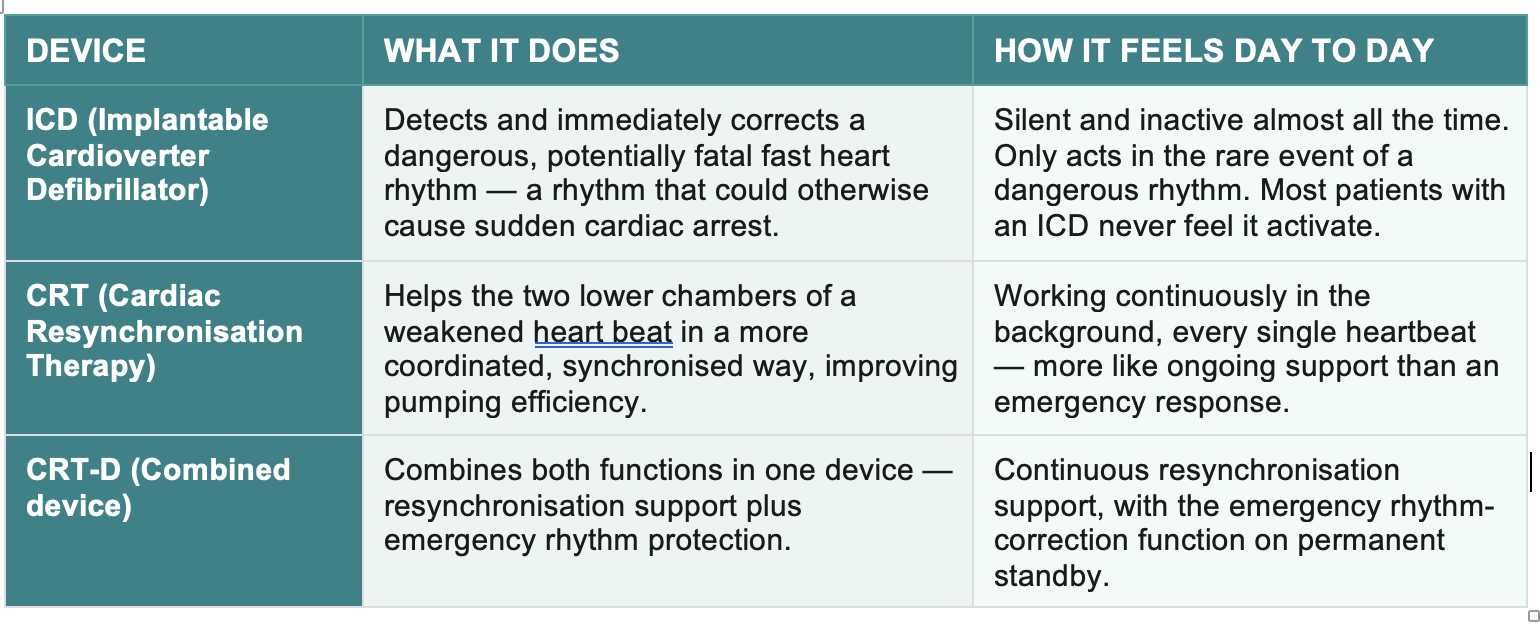
Some patients need both functions combined into a single device, called a CRT-D — resynchronisation support running continuously, with emergency rhythm protection on permanent standby.
The Airbag vs Power Steering Analogy
An ICD is like an airbag in your car. Completely invisible in everyday driving. It does nothing at all, hour after hour, day after day. But in that one specific moment when something dangerous happens, it activates instantly and does exactly the job it was built for. The vast majority of patients with an ICD go about their entire lives never once feeling it activate — which is genuinely the best possible outcome, not a sign the device isn't needed.
A CRT, on the other hand, is more like power steering. It's not waiting for an emergency. It's working continuously, quietly, in the background, every single heartbeat, helping your heart do its job a little more efficiently than it could manage alone.
What the Procedure Actually Involves
Device implantation is not open-heart surgery. It's typically done under local anaesthetic, sometimes with light sedation, through a small incision usually just below the collarbone. Thin wires, called leads, are guided through a vein into the appropriate chambers of the heart, and the device itself — roughly the size of a small stopwatch — sits just under the skin in that same area.
The procedure generally takes one to two hours, and most patients go home after one night in hospital. There's a recovery period of a couple of weeks where you'll be asked to limit lifting that arm above shoulder height, to allow everything to settle properly. Beyond that recovery window, the great majority of patients return to their normal activities — including exercise, work, and travel.
How Your Cardiologist Decides What You Need
This depends on specific factors your cardiologist has assessed — particularly your ejection fraction, the specific pattern of your heart failure, and sometimes results from specialised heart rhythm monitoring. These aren't decisions made lightly or automatically. There are clear, evidence-based criteria that determine whether a device is likely to meaningfully benefit a particular patient.
The One Question to Ask
"Which specific risk is this device protecting me against, and what does the evidence say about how much benefit someone in my situation typically gets from it?" |
This question does two things. It clarifies exactly why this device is being recommended for you personally, rather than as a generic step. And it gives you a real, evidence-based answer to hold onto — rather than being left with just a frightening word and a surgery date.
A Final Word
An ICD protects you against a dangerous heart rhythm, sitting silently until that rare moment it's needed — like an airbag. A CRT continuously helps your heart's chambers beat in better sync — like power steering. The procedure itself is far less invasive than most patients fear, typically done under local anaesthetic with sedation through a small incision, with most people home within a day or two and back to normal life within weeks.
Being offered a device is, in the great majority of cases, a sign that your care team is being proactive and protective — not a sign that things have suddenly become dire.
📋 Free downloads: 💚 Heart Failure Tracking Kit: https://www.hftk.drjodieannsenior.com 📄 My Heart Failure Stage — Personal Reference Guide (space to record device details): https://www.hfsg.drjodieannsenior.com ▶️ Watch the video version: 📖 More: drjodieannsenior.com/blog |
Aligned with the NHFA/CSANZ 2018 Guidelines for the Prevention, Detection and Management of Heart Failure in Australia.
This article is for educational purposes only. Always consult your own healthcare team about whether a device is right for you.
Heart Failure Help Now|drjodieannsenior.com|Dr Jodie-Ann Senior, Heart Failure Specialist