

My heart failure medication is making me dizzy. Is that normal?
My Heart Failure Medication Is Making Me Dizzy. Is That Normal?
By Dr Jodie-Ann Senior | Cardiologist & Heart Failure Specialist
You started your new heart failure medications. And now, when you stand up, the room tilts a little or you feel a bit light headed. Maybe you have to hold onto something to steady yourself. Maybe it passes quickly — but it's unsettling enough that you're wondering whether something is going wrong.
Let's start with the honest answer: in most cases, dizziness after starting or adjusting heart failure medication can be expected. It's a little unnerving and unsettling, that feeling of ...."oh, am I going to pass out or fall over? " but it's usually a sign the medication is doing its job — not that something has gone wrong.
But let's not just leave it there. Because 'it can be expected' isn't the same as 'here's why, here's what's normal, and here's what to watch for.' You deserve all of that.
Why It Happens — The Physiology in Plain English
Most dizziness related to heart failure medications comes down to one mechanism: a drop in blood pressure when you change position.
When you move from lying or sitting to standing, your body needs to quickly redirect blood upward against gravity — toward your brain and your heart. In a healthy system, this adjustment happens almost instantly: blood vessels tighten reflexively, heart rate nudges up, and you feel next to nothing. This is how it should be. In normal healthy adults, there are circumstances where this might happen in a very mild way - if your baseline blood pressure happens to be low, you get dehydrated, add a warm environment, and say squat down or bend to the ground then get up to quickly. Your body's systems just don't quite have enough capacity to change fast enough. But with heart conditions like heart failure, the blood pressure is often lower, and then the medications can add to the slowness of the body's natural systems to react.
Many heart failure medications work by relaxing blood vessels and slowing the heart. That's precisely how they reduce the strain on your heart — and it's why they're so effective. The trade-off is that your body's ability to make that rapid adjustment when you stand becomes a little slower.
The result is a brief dip in blood pressure when you change position. For a moment, your brain receives slightly less blood flow than it needs. That's the dizziness / feeling off balance / light headed feeling you get.
The medical term for this is orthostatic hypotension — a drop in blood pressure on standing. In the context of a new or recently adjusted heart failure medication, it's a common and expected side effect.
Why it often happens at dose increases:
Standard practice with heart failure medications — especially beta-blockers and ACE inhibitors — is to start on a low dose and increase gradually over weeks or months. Each time the dose goes up, your body recalibrates. A brief return of dizziness at each step is expected, and it usually settles again as your body adjusts to the new level.
Which Medications Are Most Likely Causing It
Knowing which tablet is most likely behind the dizziness gives you something useful to tell your doctor — and helps you understand what to expect as each medication is titrated. Here is a table of the most common types of heart failure medications and why they can cause dizziness, plus what to do.
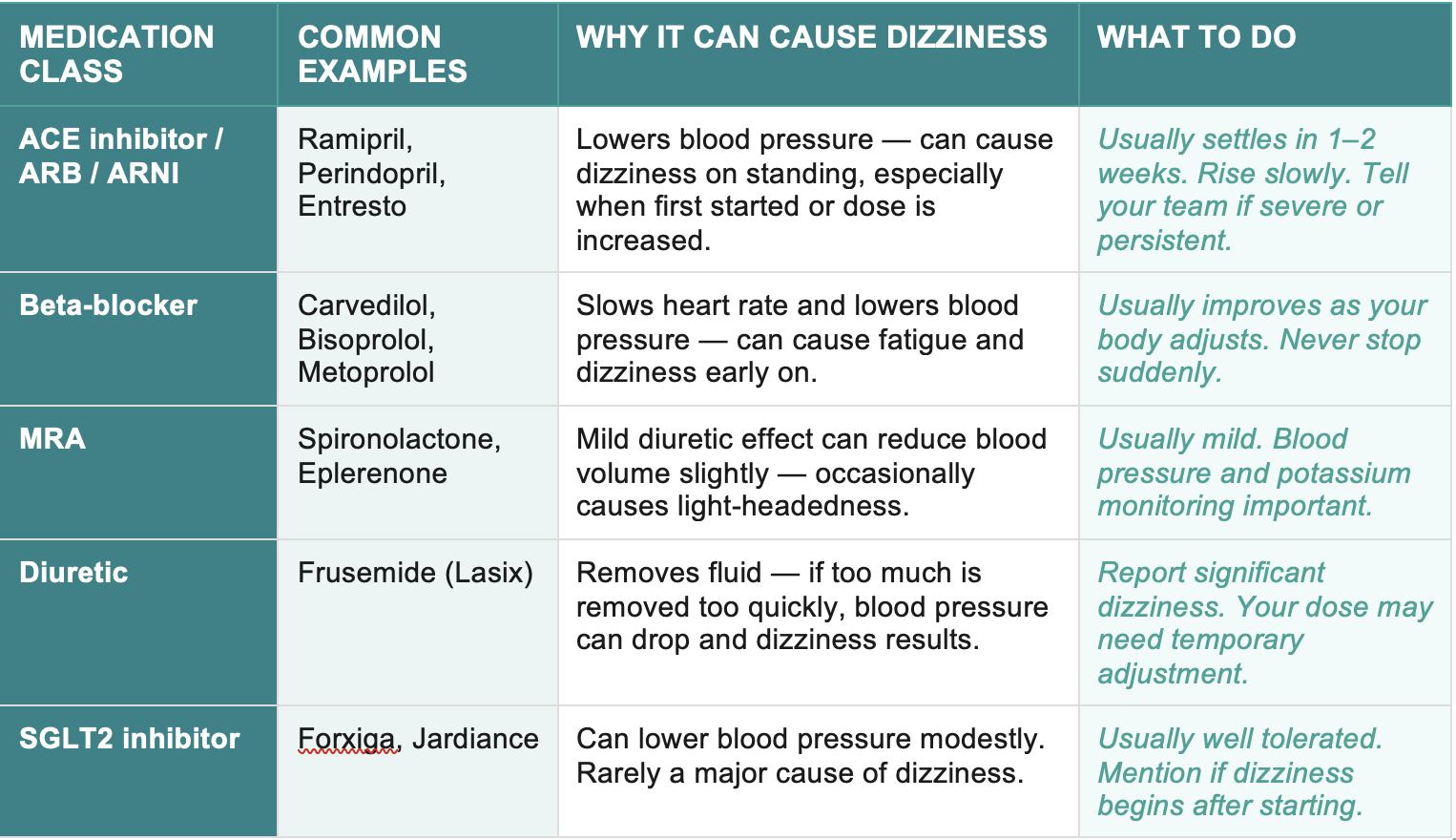
MEDICATION CLASS
What's Expected vs What's a Warning Sign
This is the distinction that matters most. Not all dizziness is the same.
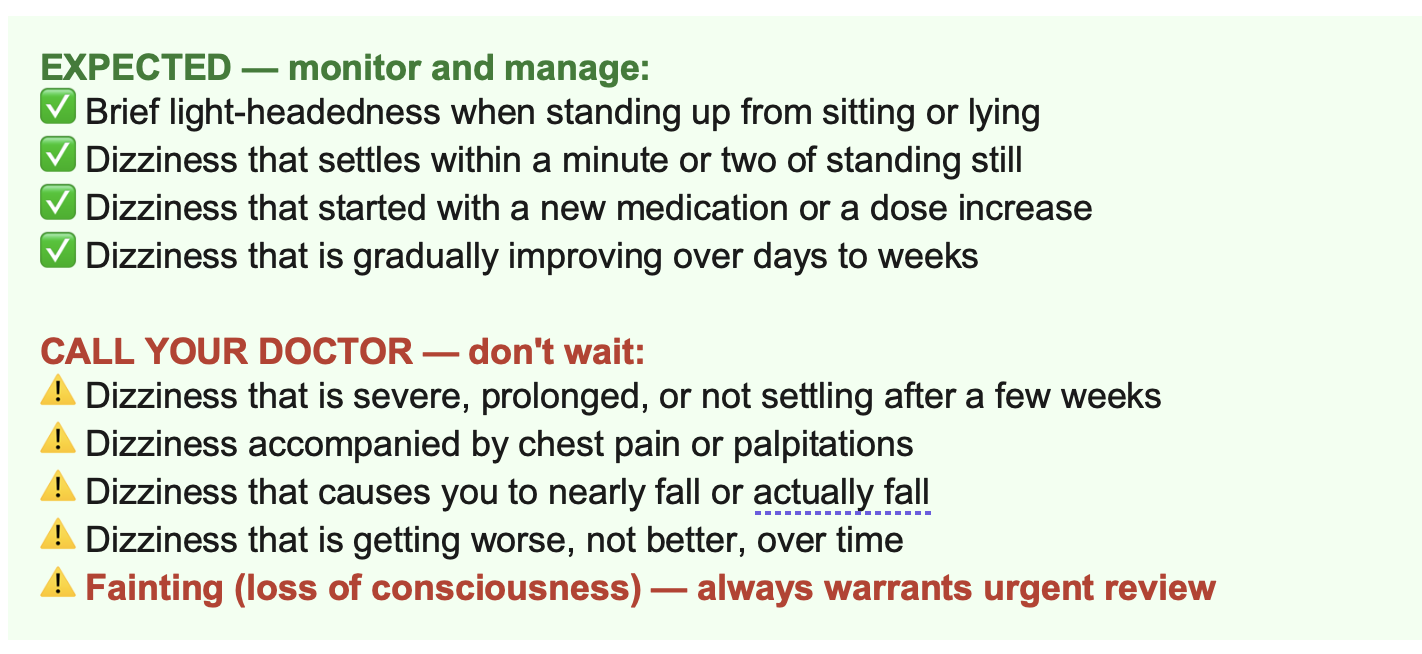
If you are unsure whether what you're experiencing is expected or a warning sign, contact your care team. It is always better to check to see if they are concerned about the symptoms you are experiencing than to not mention it. And definitely better than to quietly stop a medication that is protecting your heart.
Five Things You Can Do to Manage It
1. Rise slowly — always
Move from lying to sitting, then pause for thirty seconds before you stand. Give your blood pressure time to catch up with your change in position. This single habit makes a meaningful difference.
2. Sit on the edge of the bed before you stand in the morning
Morning is the highest-risk time for postural dizziness. Your blood pressure is at its lowest after hours of lying flat. Sitting on the edge of the bed before you stand — and pausing there — is one of the most practical things you can do.
3. Move your legs.
Move your legs, raise your heels up and down, point your toes for a minute or so before standing. This helps the blood flow and increases the circulation after a long period lying or sitting.
4. Hold onto something when you stand
A bedhead, a wall, a bench. Until the dizziness settles consistently, having a physical anchor reduces the risk of a fall. Falls in people with heart failure carry real consequences — this is practical safety, not overcaution.
5. Keep your fluid intake up within your prescribed limit
Dehydration makes postural dizziness significantly worse. If you're not sure what your fluid limit is, ask your care team. Sweating heavily, hot weather, or illness can all shift your fluid balance and worsen dizziness — worth mentioning if your symptoms have changed recently.
6. Track it
Note when the dizziness happens, how long it lasts, what you were doing beforehand, and whether it's improving or worsening over time. This gives your care team something concrete to work with — especially if you need a medication review. My free Heart Failure Tracking Kit includes a daily symptom diary for exactly this purpose.
The One Thing I Really Need You to Know
Please don't stop your heart failure medications without speaking to your doctor first.
I understand the dizziness is uncomfortable. But these medications are doing important, life-extending work for your heart — and stopping them suddenly, particularly a beta-blocker, can be potentially dangerous.
If the side effects are affecting your quality of life, tell your team. There are almost always options: a dose adjustment, a timing change, a switch to an alternative medication. But those options only become available when your team knows what's happening.
You don't have to just put up with it. But you also don't have to manage it alone — or by stopping a medication that is protecting you.
A Quick Word on When to Seek Help Today
If you experience any of the following, contact your doctor or heart failure nurse today — don't wait for your next scheduled appointment:
•Dizziness severe enough to cause a fall or near-fall
•Dizziness accompanied by chest pain, tightness, breathlessness or palpitations
•Fainting, near fainting or loss of consciousness
•Dizziness that is worsening significantly after weeks on a stable dose
If you are ever in doubt — call. Your care team would always rather hear from you.
A Final Word
Dizziness after starting heart failure medications is fairly common, understandable, and in most cases temporary. Your body is adjusting to medications that are genuinely changing how hard your heart has to work. That adjustment takes a little time.
Now you know what's happening, which tablet is most likely responsible, what to watch for, and what to do. That knowledge means you can manage this with more confidence — and keep taking the medications that are protecting your heart.
📋 Free downloads:
💚 Heart Failure Tracking Kit (includes symptom diary to track dizziness): https://www.hftk.drjodieannsenior.com
📄 My Heart Failure Stage — Personal Reference Guide: https://www.hfsg.drjodieannsenior.com
▶️ Watch the video version:
📖 More: drjodieannsenior.com/blog
Aligned with the NHFA/CSANZ 2018 Guidelines for the Prevention, Detection and Management of Heart Failure in Australia.
This article is for educational purposes only. It is not a substitute for individual medical advice from your own healthcare team.