
What Is An Echocardiogram and What Will It Show About My Heart?
Photo by Joshua Chehov on Unsplash
What Is an Echocardiogram and What Will It Show About My Heart?
By Dr Jodie-Ann Senior | Cardiologist & Heart Failure Specialist
You've been booked for an echocardiogram. Someone handed you a piece of paper, or sent a text message with a date and time, and that was pretty much it.
Nobody sat down and explained what it actually is, what's going to happen, or what they're even looking for. So you're left filling in the gaps yourself — and without real information, imagination tends to fill that gap with something far more alarming than the truth.
Let's take away the mystery.
Echocardiogram vs ECG — The Confusion That Trips Everyone Up
An echocardiogram is not the same as an ECG, even though the names sound almost identicalWhat it uses

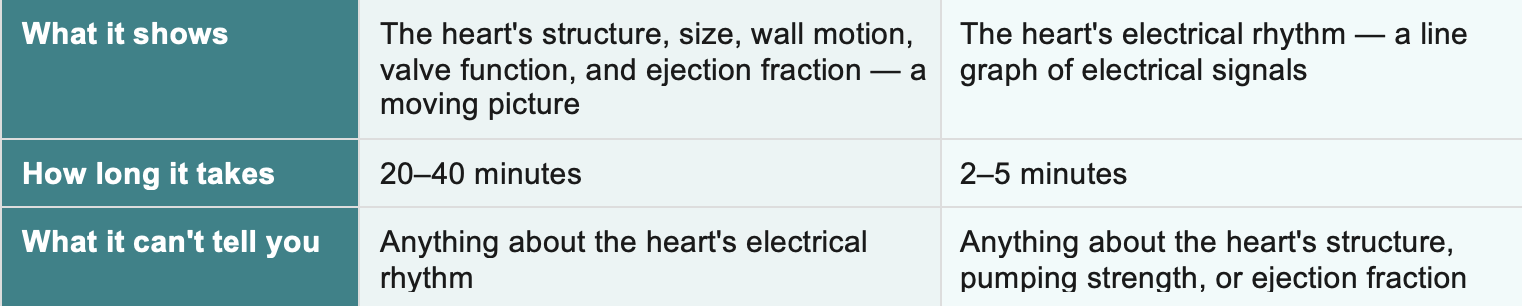
If you've ever seen an ultrasound image of a baby, or know someone who has, you already have a mental picture of how an echocardiogram works. A probe moves gently across your chest, sound waves bounce back from the structures inside, and that creates a moving, real-time picture of your heart — instead of a baby, it's your own heart, beating, right there on the screen.
What an Echocardiogram Actually Measures
An echocardiogram gives your cardiologist an enormous amount of information in one appointment.
•The size of each chamber of your heart
•How thick or thin the heart muscle walls are
•How well each chamber contracts and relaxes with every beat
•Whether your heart valves are opening and closing properly, or whether there's narrowing or leaking
•Your ejection fraction — the percentage of blood your heart pumps out with each beat
All of that, from one test, without a single needle, without any radiation, and without any pain.
What Happens During the Appointment
You'll be asked to lie on an examination bed, usually on your left side, which brings your heart slightly closer to your chest wall for a clearer picture. A small amount of gel is applied to your chest — similar to a pregnancy ultrasound — helping the sound waves transmit properly.
The sonographer, the specially trained person performing the scan, moves a small handheld probe across different areas of your chest, pausing at various points to capture specific views and measurements. You might feel gentle pressure as the probe is held in particular positions, but the test itself is not painful. You may be asked to briefly hold your breath or shift position slightly for the clearest images.
The whole appointment usually takes twenty to forty minutes, depending on how straightforward or complex the views are.
The sonographer may be quiet and focused throughout — this is simply careful, precise work, not a sign that something is wrong.
Why You Might Not Get Results on the Day
The sonographer performing your scan will very often not be able to tell you the results immediately. This isn't because they're hiding anything — interpreting an echocardiogram properly is a specialised skill, and the images need to be formally reviewed and reported by a cardiologist, sometimes alongside comparison to previous scans.
That formal report is what your own doctor uses to discuss the results with you. If you leave your echo appointment without immediate answers, that is completely normal, not a cause for concern.
The One Thing to Do Before Your Results Appointment
Before that follow-up appointment, write down three specific questions:
•What is my ejection fraction, and has it changed since my last scan?
•Is there anything about my heart's structure or valves that needs monitoring or treatment?
•Based on these results, does anything about my current medication or management plan need to change?
Walking into that results appointment with three specific questions transforms it from a passive experience into an active conversation where you leave with concrete, useful information.
A Final Word
An echocardiogram isn't something to fear. It's one of the most valuable, painless, and informative tests we have in heart failure care — and now you know exactly what it is, what to expect, and how to make the most of what it tells us.
📋 Free downloads:
💚 Heart Failure Tracking Kit: https://www.hftk.drjodieannsenior.com
📄 My Heart Failure Stage — Personal Reference Guide (space to record echo results): https://www.hfsg.drjodieannsenior.com
▶️ Watch the video version:
📖 More: drjodieannsenior.com/blog
Aligned with the NHFA/CSANZ 2018 Guidelines for the Prevention, Detection and Management of Heart Failure in Australia.
This article is for educational purposes only. Always consult your own healthcare team about your specific test results and treatment.
Heart Failure Help Now|drjodieannsenior.com|Dr Jodie-Ann Senior, Heart Failure Specialist