
My Ejection Fraction Is 35%. What Does That Mean For Me?

Photo by Joshua Chehov on Unsplash
My Ejection Fraction Is 35%. What Does That Mean For Me?
By Dr Jodie-Ann Senior | Cardiologist & Heart Failure Specialist
Your doctor told you your ejection fraction is 35%. And you nodded.
Maybe you even said 'okay' with some confidence. But if you're honest with yourself, you had no real idea what that number meant for your life. Is it bad? Dangerous? Something you can improve, or a permanent fact about your heart now?
You are absolutely not alone in that. Ejection fraction is one of the most commonly quoted numbers in heart failure — and one of the least well explained. Let's fix that.
The Mistake Almost Every Patient Makes
We're conditioned, from school onward, to think of percentages as grades. Ninety percent is excellent. Fifty percent is a fail. So when a patient hears 'your ejection fraction is 35%,' the instinctive reaction is: I'm failing. My heart is barely working. This is catastrophic.
That mental model is wrong, and it causes a huge amount of unnecessary fear.
Ejection fraction isn't a grade on how well your heart is functioning overall. It's a specific, narrow measurement of one particular thing your heart does. Once you understand what that one thing is, the number stops being frightening and starts being useful.
What Ejection Fraction Actually Measures
Think of your heart's main pumping chamber — the left ventricle — like a cup that never completely empties. With every heartbeat, that cup fills with blood, then squeezes to push some of it out to the rest of your body. It doesn't push out everything. It never does, even in a completely healthy heart. Some blood always remains behind, ready for the next fill.
Ejection fraction is simply the percentage of the blood in that cup that gets pushed out with each squeeze.
If your ejection fraction is 35%, your heart is pushing out 35% of the blood in that chamber with each beat, keeping the remaining 65% behind until the next beat. A normal, healthy heart typically pushes out somewhere between 55 and 70% per beat.
Your heart at 35% is doing the same fundamental job as a healthy heart — filling, squeezing, pushing blood around your body, continuously. It's just doing that job with a smaller percentage of ejection per beat, which often means it needs to work a little harder or faster to deliver what your body needs.
Understanding the Ranges
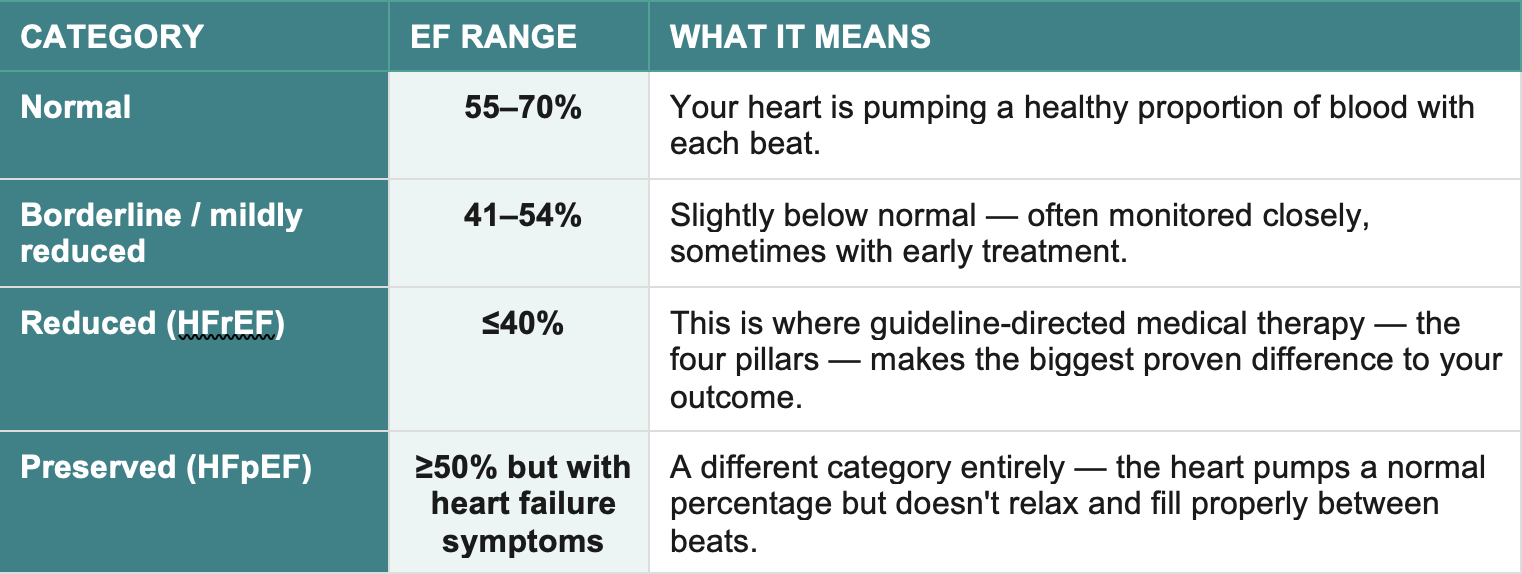
CATEGORY
At 35%, you fall into the reduced category — sometimes written as HFrEF, heart failure with reduced ejection fraction. And here's the genuinely important part: this is the category where modern heart failure treatment has the most robust, most proven evidence behind it.
The four pillars of guideline-directed medical therapy — medications that block harmful hormones, protect against adrenaline overload, manage fluid at a hormonal level, and protect your heart and kidneys — all have their strongest, clearest evidence specifically in patients with a reduced ejection fraction like yours.
Can Ejection Fraction Improve?
Yes. Ejection fraction is not fixed, and it is not a permanent life sentence at whatever number you were first given.
For many patients, with consistent use of the four pillars of therapy, ejection fraction improves over time — sometimes significantly. Patients moving from a reduced ejection fraction into the normal range with sustained treatment is well documented in the medical literature, and it happens more often than most patients are told to expect.
This is exactly why taking your medications consistently matters so much, even when you don't feel an immediate difference. Your ejection fraction today is a snapshot, not a verdict. It's the starting point for tracking your progress — not the ceiling on what's possible.
One Action to Take Today
Write your ejection fraction number down, along with today's date. Somewhere you'll actually find it again.
Ejection fraction is measured again at future echocardiograms, and the single most useful piece of information you can have at that next appointment is your own personal baseline to compare against. Is it staying the same? Improving? That trend, tracked over time, tells a far more meaningful story than any single number in isolation.
Your ejection fraction is not a grade on how well you're doing as a person. It's one specific measurement that tells your care team exactly which treatments give you the best chance of the outcome you actually want — feeling better, staying out of hospital, and potentially watching that number improve over time.
📋 Free downloads:
💚 Heart Failure Tracking Kit: https://www.hftk.drjodieannsenior.com
📄 My Heart Failure Stage — Personal Reference Guide (includes EF quick reference): https://www.hfsg.drjodieannsenior.com
▶️ Watch the video version:
📖 More: drjodieannsenior.com/blog
Aligned with the NHFA/CSANZ 2018 Guidelines for the Prevention, Detection and Management of Heart Failure in Australia.
This article is for educational purposes only. Always consult your own healthcare team about your specific results and treatment.
Heart Failure Help Now|drjodieannsenior.com|Dr Jodie-Ann Senior, Heart Failure Specialist