
Can You Exercise With Heart Failure?
⭐️ Can You Exercise With Heart Failure? A Safe, Practical Guide.
After being diagnosed with heart failure, one of the most common questions people ask is:
“Can I still exercise?”
And often, that question comes with a bit of uncertainty.
Because for many years, people were told to rest or to take it easy when it came to heart conditions. In the past, people were actually told to stay in bed and not exert themselves out of fear that it would be dangerous for them.
So it’s completely understandable to wonder whether being active is safe — or whether it might actually make things worse.
Let’s take a moment to clarify that.
The Short Answer
In most cases:
Yes — you can exercise with heart failure.
And more than that, the right kind of activity is actually proven to be beneficial.
Why This Matters
The body is designed to move.
When we become less active, a few things tend to happen:
• muscles gradually weaken
• energy levels drop
• everyday tasks feel harder
• fatigue becomes more noticeable
Over time, this can create a cycle where doing less leads to feeling worse — and feeling worse leads to doing even less. This can become a silent sneaky vicious cycle where the less you do means the less you can do.
BUT
The opposite is also true. If you think about this like cautious training, you can improve what you can do every day. Over time, because you do more you train your body to be able to handle more activity.
Gentle, regular activity helps interrupt that cycle.
What Exercise Does for You
When done appropriately, activity can:
• improve circulation
• help maintain muscle strength
• reduce fatigue over time
• support overall wellbeing
• improve confidence in your body
And importantly, it can help you feel more capable in day-to-day life.
What “Safe Exercise” Looks Like
This is where many people feel unsure.
Exercise in heart failure isn’t about pushing yourself or trying to reach a particular level of fitness.
It’s about steady, manageable movement.
This might include:
• walking at a comfortable pace
• light cycling
• gentle resistance exercises
• structured cardiac rehabilitation programs
The focus is not intensity.
It’s consistency.
A Simple Way to Think About It
A helpful guide is this:
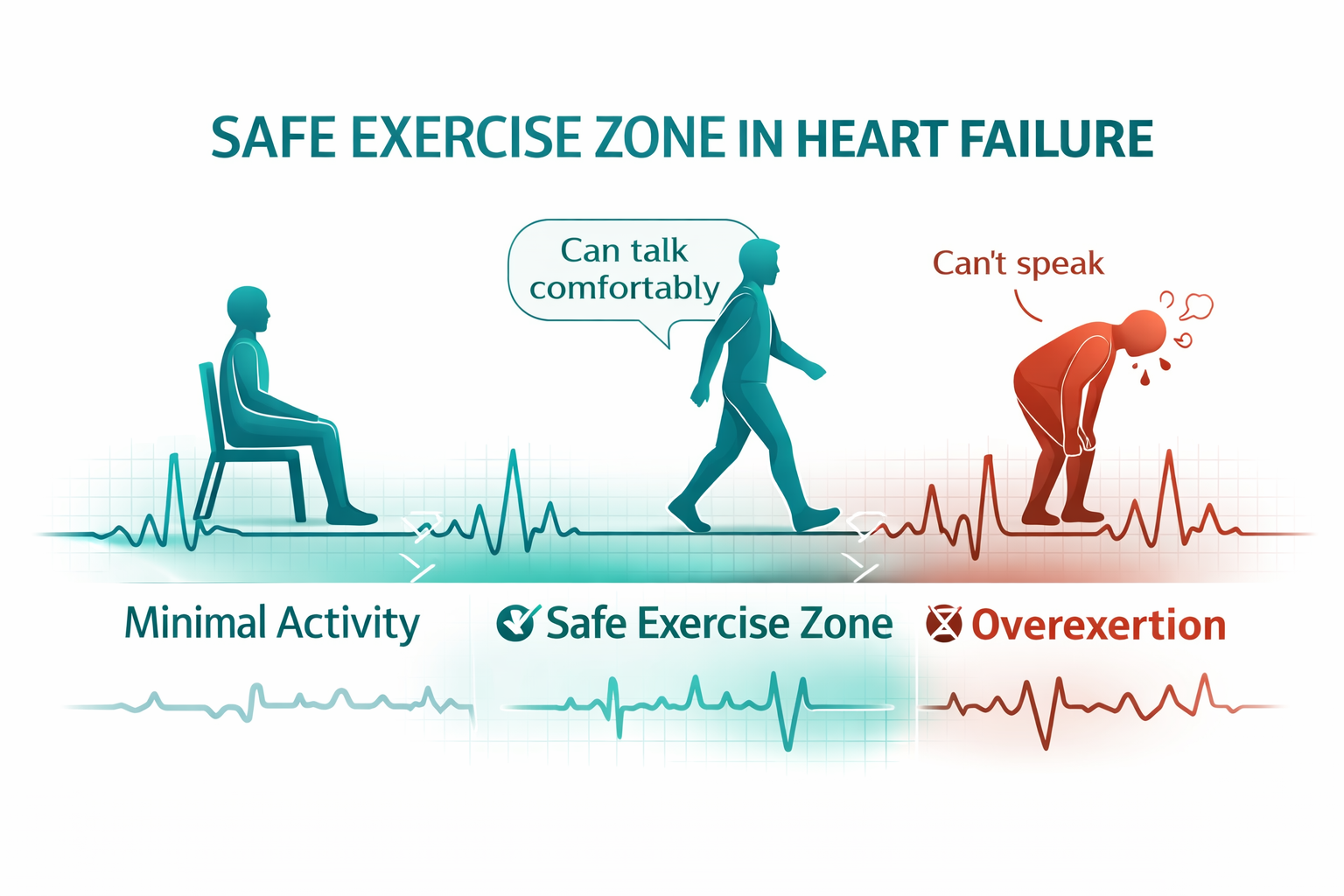
You should be able to carry on a conversation while you’re moving.
If you’re too breathless to speak comfortably, that’s usually a sign to slow down.
Listening to Your Body
Your body will give you useful feedback.
Exercise should feel:
• manageable
• controlled
• sustainable
It shouldn’t leave you:
• very breathless
• dizzy or lightheaded
• exhausted for hours afterwards
If it does, it’s a sign that things may need to be adjusted.
Rebuilding Confidence
For many people, the biggest challenge isn’t physical — it’s confidence.
After a diagnosis like heart failure, it’s natural to feel cautious.
That’s why structured programs such as cardiac rehabilitation can be so helpful. They provide guidance, monitoring, and a safe way to rebuild trust in your body.
What About Bad Days?
There will be days when you feel more tired or more breathless than usual.
On those days, it’s completely reasonable to do less — or to rest.
Managing heart failure isn’t about pushing through no matter what.
It’s about responding to your body appropriately.
The Bigger Picture
Exercise in heart failure is not about performance.
It’s about maintaining function.
It’s about helping your body work as well as it can — and supporting your overall quality of life.
With the right approach, movement becomes part of your treatment, not something to avoid.
Watch: Exercise Explained
If you prefer to hear this talked through step-by-step, I’ve also explained this in a short video.
You’re Not Alone in This
If you’ve found this helpful, you’re not alone in trying to make sense of all of this.
I share simple, practical guidance on heart failure — the kind of information I wish every patient had from the beginning.
You’re very welcome to join if that would be helpful.
** Information on this site is based on international heart failure guidelines including ESC and AHA recommendations.