
My BNP Level Is High. What Does That Mean?
My BNP Level Is High. What Does That Mean?
By Dr Jodie-Ann Senior | Cardiologist & Heart Failure Specialist
Your blood results came back. Your BNP is elevated. Your doctor looked a little concerned, said a few words, and moved on — and you were left holding a number with no real idea what it meant.
You're not alone. BNP is one of the most commonly ordered blood tests in heart failure care, and one of the least well explained. Let's properly unpack it.
What BNP Actually Is
BNP stands for B-type natriuretic peptide — a hormone released by your heart muscle, specifically in greater amounts when the walls of your heart are being stretched under increased pressure or volume.
Think of it like your heart's version of a smoke alarm. When there's more strain on the heart wall, your heart releases more BNP — the same way a smoke alarm gets louder the more smoke is actually in the room. A higher BNP level signals that your heart is under more strain than it should be.
That's genuinely useful information. But like any alarm, there's important context — and other things nearby can affect how loud it sounds, independent of the actual fire.
Why BNP Is a Trend Marker, Not a Yes-or-No Test
BNP is not a diagnostic on/off switch. It's far more useful as a trend, tracked over time alongside your other results and symptoms, than as a single isolated number.
A high BNP is genuinely useful for confirming heart failure as a likely explanation for symptoms like breathlessness, particularly in an urgent care setting. But once you have an established heart failure diagnosis, a single reading needs to be interpreted carefully, alongside several other factors.
What Else Affects Your BNP Number
My BNP Level Is High. What Does That Mean?
By Dr Jodie-Ann Senior | Cardiologist & Heart Failure Specialist
Your blood results came back. Your BNP is elevated. Your doctor looked a little concerned, said a few words, and moved on — and you were left holding a number with no real idea what it meant.
You're not alone. BNP is one of the most commonly ordered blood tests in heart failure care, and one of the least well explained. Let's properly unpack it.
What BNP Actually Is
BNP stands for B-type natriuretic peptide — a hormone released by your heart muscle, specifically in greater amounts when the walls of your heart are being stretched under increased pressure or volume.
Think of it like your heart's version of a smoke alarm. When there's more strain on the heart wall, your heart releases more BNP — the same way a smoke alarm gets louder the more smoke is actually in the room. A higher BNP level signals that your heart is under more strain than it should be.
That's genuinely useful information. But like any alarm, there's important context — and other things nearby can affect how loud it sounds, independent of the actual fire.
Why BNP Is a Trend Marker, Not a Yes-or-No Test
BNP is not a diagnostic on/off switch. It's far more useful as a trend, tracked over time alongside your other results and symptoms, than as a single isolated number.
A high BNP is genuinely useful for confirming heart failure as a likely explanation for symptoms like breathlessness, particularly in an urgent care setting. But once you have an established heart failure diagnosis, a single reading needs to be interpreted carefully, alongside several other factors.
What Else Affects Your BNP Number
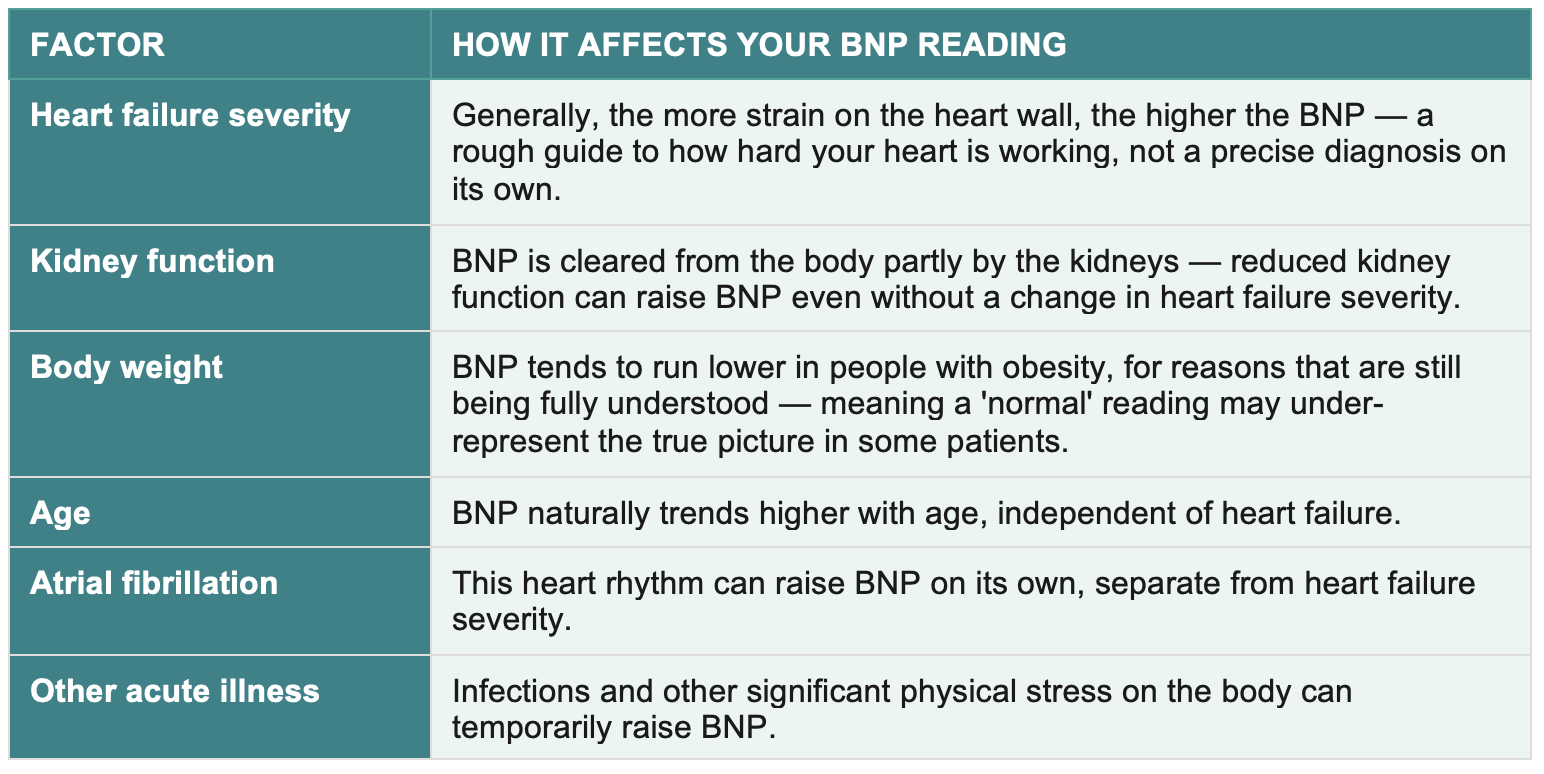
This is exactly why your cardiologist doesn't look at a single BNP number in isolation. They're weighing it against your kidney function, your weight, your age, your heart rhythm, whether you're otherwise unwell — and critically, how it compares to your own previous results.
The One Thing To Do With Your Result
Don't settle for being told your BNP is simply 'high' or 'normal.' Ask for the actual number, and write it down with the date. |
Your own BNP trend over time — rising, falling, or stable — tells your care team a far more meaningful story than any single reading compared to a generic reference range. If your BNP has been trending upward over several visits, that's worth a specific conversation about whether your treatment needs adjusting. If it's stable or trending down, that's genuinely reassuring information worth knowing rather than assuming.
A Final Word
BNP is a hormone your heart releases when its walls are under more stretch or strain than usual — a smoke alarm for your heart, not a definitive diagnosis on its own. A single high reading is useful information, but it needs to be interpreted alongside your kidney function, your weight, your age, your heart rhythm, and whether you're otherwise unwell.
The single most valuable thing you can do is track your own number over time, rather than treating one result as the whole story. Ask for your actual number today. Write it down. It's the beginning of a trend that will serve you at every future appointment.
📋 Free downloads: 💚 Heart Failure Tracking Kit: https://www.hftk.drjodieannsenior.com 📄 My Heart Failure Stage — Personal Reference Guide (space to record BNP + EF): https://www.hfsg.drjodieannsenior.com ▶️ Watch the video version: [YouTube LINK] 📖 More: drjodieannsenior.com/blog |
This is exactly why your cardiologist doesn't look at a single BNP number in isolation. They're weighing it against your kidney function, your weight, your age, your heart rhythm, whether you're otherwise unwell — and critically, how it compares to your own previous results.
The One Thing To Do With Your Result
Don't settle for being told your BNP is simply 'high' or 'normal.' Ask for the actual number, and write it down with the date. |
Your own BNP trend over time — rising, falling, or stable — tells your care team a far more meaningful story than any single reading compared to a generic reference range. If your BNP has been trending upward over several visits, that's worth a specific conversation about whether your treatment needs adjusting. If it's stable or trending down, that's genuinely reassuring information worth knowing rather than assuming.
A Final Word
BNP is a hormone your heart releases when its walls are under more stretch or strain than usual — a smoke alarm for your heart, not a definitive diagnosis on its own. A single high reading is useful information, but it needs to be interpreted alongside your kidney function, your weight, your age, your heart rhythm, and whether you're otherwise unwell.
The single most valuable thing you can do is track your own number over time, rather than treating one result as the whole story. Ask for your actual number today. Write it down. It's the beginning of a trend that will serve you at every future appointment.
📋 Free downloads: 💚 Heart Failure Tracking Kit: https://www.hftk.drjodieannsenior.com 📄 My Heart Failure Stage — Personal Reference Guide (space to record BNP + EF): https://www.hfsg.drjodieannsenior.com ▶️ Watch the video version: [YouTube LINK] 📖 More: drjodieannsenior.com/blog |
📖 More: drjodieannsenior.com/blog
Aligned with the NHFA/CSANZ 2018 Guidelines for the Prevention, Detection and Management of Heart Failure in Australia.
This article is for educational purposes only. Always consult your own healthcare team about your specific results and treatment.
Heart Failure Help Now|drjodieannsenior.com|Dr Jodie-Ann Senior, Heart Failure Specialist